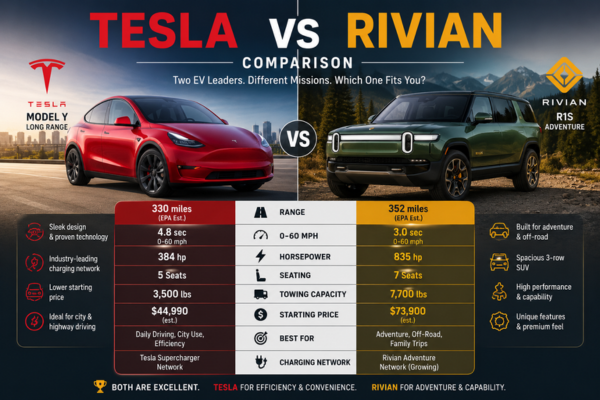
The electric vehicle market in the United States has grown rapidly over the past few years, and two of the most talked-about manufacturers are Tesla and Rivian. While both companies focus on all-electric transportation, they approach the market in very different ways. This Comparison highlights the strengths and weaknesses of each brand, helping potential buyers understand which company may better fit their lifestyle and driving needs. Tesla has established itself as the leading EV manufacturer with a broad lineup of sedans, SUVs, and a pickup truck, while Rivian has gained attention with its rugged, adventure-focused electric trucks and SUVs designed for outdoor enthusiasts.
When it comes to vehicle lineup and performance, Tesla offers a wider range of choices. Popular models such as the Tesla Model 3, Tesla Model Y, Tesla Model S, and Tesla Model X appeal to different types of drivers, from daily commuters to luxury buyers. Tesla vehicles are known for their impressive acceleration, efficient battery technology, and long driving ranges. Rivian currently focuses on the Rivian R1T pickup truck and the Rivian R1S SUV. These vehicles deliver excellent off-road capability, strong towing performance, and premium interiors designed for adventure travel. In this Comparison, Tesla has an advantage in overall model variety, while Rivian stands out for buyers who prioritize outdoor recreation and rugged capability.
Technology is another area where the two brands differ. Tesla is widely recognized for its software ecosystem, over-the-air updates, and advanced driver-assistance features. The company continuously improves vehicle functionality through software updates, allowing owners to receive new features without visiting a dealership. Tesla’s infotainment system is among the most advanced in the automotive industry, offering a responsive user experience and seamless integration of vehicle controls. Rivian also provides a modern digital experience with large touchscreens and software updates, but its technology platform is still developing compared to Tesla’s mature ecosystem. As part of this Comparison, buyers seeking cutting-edge software and advanced connectivity may find Tesla to be the stronger option.
Charging infrastructure plays a major role in EV ownership. Tesla’s Supercharger network remains one of the largest and most reliable fast-charging networks in North America. Tesla owners benefit from thousands of charging locations that make long-distance travel more convenient. Rivian has been expanding its Adventure Network, but it remains significantly smaller than Tesla’s charging infrastructure. However, Rivian owners can access many third-party charging stations across the country. In this Comparison, Tesla’s charging advantage is a major factor for drivers who frequently travel long distances or want the convenience of a well-established charging ecosystem.
Pricing and ownership experience also influence purchasing decisions. Tesla offers vehicles across several price points, making the brand accessible to a wider range of consumers. The Tesla Model 3 and Tesla Model Y are among the most popular EVs in America due to their balance of performance, range, and value. Rivian vehicles generally occupy the premium segment, with pricing reflecting their specialized design, luxury features, and off-road capabilities. Rivian owners often praise the brand’s build quality, unique design, and customer service experience. This Comparison shows that Tesla may offer better value for mainstream buyers, while Rivian appeals to customers seeking a premium adventure-focused electric vehicle.
Brand identity is another important consideration. Tesla is viewed as a technology-driven company that has played a major role in accelerating EV adoption worldwide. The brand attracts buyers who value innovation, efficiency, and future-focused transportation. Rivian has built its reputation around exploration, sustainability, and outdoor lifestyles. Its vehicles are designed for camping, overlanding, and off-road adventures while maintaining the benefits of electric mobility. In this final Comparison, the choice ultimately depends on what buyers want from their EV. Tesla remains the stronger option for charging convenience, software technology, and vehicle selection, while Rivian excels in premium craftsmanship, utility, and adventure-ready performance. Both brands represent the future of electric transportation and continue to push innovation within the rapidly growing EV market.